
Castelao. Looking out for Galicia presents the most advanced digital art experience to date centred on Alfonso Daniel Rodríguez Castelao — a journey through the personal, literary, artistic and political life of one of the most iconic figures in Galician history.
Artificial intelligence, holograms, videomapping and virtual reality come together in a narrative that offers a renewed perspective on Castelao’s life, his legacy, and his artistic universe — recreated through the possibilities of cutting-edge 3D animation and generative AI technologies.
Framed within the Xunta de Galicia’s official programme to commemorate Castelao Year 2025, the exhibition is guided by the historical expertise and direction of Miguel Anxo Seixas Seoane, president of the Castelao Foundation and widely regarded as the foremost authority on Castelao’s biography, work, and legacy.
The project’s artistic direction is led by Carlos Seijo, co-founder of the Galician studio Maxina and responsible for the animations and digital production of the exhibition. A specialist in visual effects, 3D animation, visualisation, and immersive experiences, Seijo has more than a decade of experience collaborating with institutions such as the Guggenheim Museum Bilbao and Netflix, as well as with the Xunta de Galicia on projects like Orixes and Hábitats, both at the Gaiás.
A human and personal perspective
January 2025 marks the 75th anniversary of Castelao’s passing (Rianxo, 1886 – Buenos Aires, 1950). This exhibition presents both the human being and the artist, in an experience that combines digital technologies with his original work.
Castelao. Looking out for Galicia invites visitors to discover the person behind the iconic figure of the celebrated author, artist, politician and intellectual of the Generation of 1916. From seeing the world through Castelao’s eyes in a virtual reality experience, to attending a recreation of his drawing classes in Pontevedra, or opening a window into his childhood, youth, and years in exile after the Civil War — these are just some of the scenes visitors can explore at the Gaiás Centre Museum.
An intimate and personal view that evokes both his artistic vitality and his humanity.
Inmersive experience with videomapping
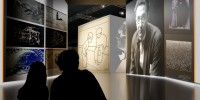
An immersive installation inside a large paper-like cube, combining videomapping and quadraphonic sound, captures Castelao’s life journey and creative legacy. Told in the first person through a curated selection of his texts and artworks, the experience brings his voice and imagery to life using 3D animation and generative artificial intelligence.
This is an artistic reinterpretation of his creative spirit, developed without compromising historical accuracy — a tribute to Castelao’s legacy, crafted with care and precision by a team of Galician professionals and creators. The installation also offers a unique opportunity to hear the intellectual’s words once again — in Galician, and in his own voice, recreated through a meticulous process that blends quotations from his writings, the work of professional actors and voice artists, and cutting-edge AI voice synthesis.
Ethical use of AI and a deeply human approach
At a time when generative AI is rapidly expanding, Castelao. Looking out for Galicia embraces these technologies in an ethical and responsible way, while never losing sight of the essential role of the human creator.
The experience is the result of a thorough documentation process, drawing from an extensive visual archive of personal photographs and drawings by Castelao, compiled from various libraries, museums, and archives.
To make this exhibition possible, the project has relied on the generous collaboration of many of Galicia’s most important cultural institutions, who contributed materials either as original objects or reproductions for display, or for use in the digital and audiovisual recreations:
- Museo de Pontevedra
- Filmoteca de Galicia
- Consello da Cultura Galega / Arquivo Sonoro de Galicia
- Afundación
- Fundación Castelao
- Biblioteca de Galicia
- Fundación Eduardo Blanco Amor / Deputación provincial de Ourense
- Arquivo Pacheco. Concello de Vigo
- Biblioteca Nacional de España
- Arquivo da Real Academia Galega
- Recreo Cultural da Estrada
- Biblioteca Municipal Rosalía de Castro / Concello de Arzúa
- Along with other private contributors